The Russian campaign, after Minard: a homage in motion
May past wars remind us, in troubled times, that war is never inevitable, and that our history binds us more than it divides us. We owe it to those who marched, and to those who will.
Pascal Thomet, October 2026
What the animation adds
Minard's map, drawn in 1869, bears almost no dates. The animation adds time: the advance is placed at sourced dates for the cities it passed, the retreat at Minard's own dated readings, and the detachments' timing is approximate.
The redrawing follows Minard's map, not the real geography. It places his figures where his own map does, and bends the geography as he did, from his band's turns and splits measured on the 1869 sheet. The rivers come from Natural Earth (public domain), simplified, and bend with it.
Beyond Minard's map
Minard's figurative map mainly shows the army's advance along a single road. For a better idea of the number of men who came back, according to the different historical sources, see the page “Beyond Minard's map”.
The original
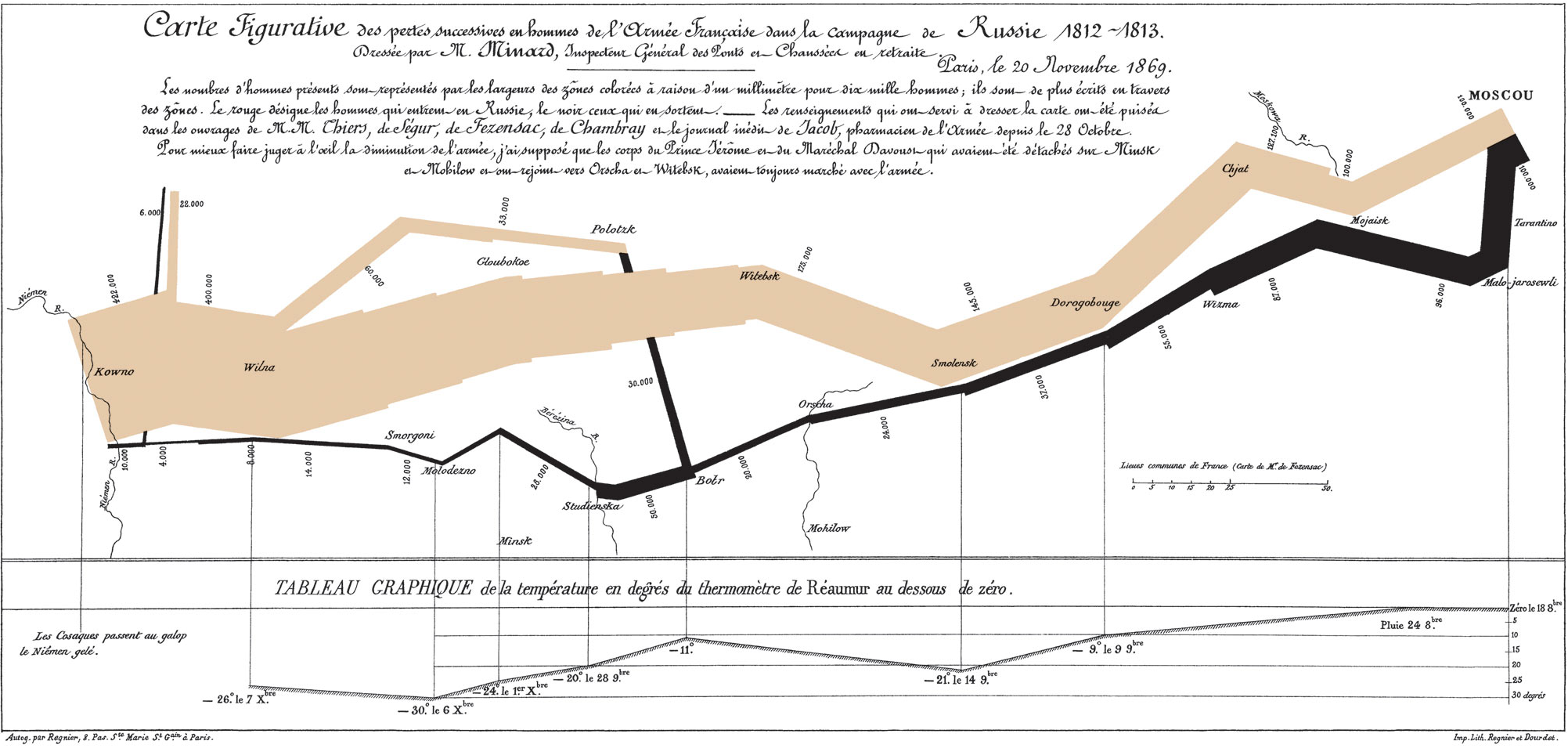
He printed it on one sheet with a map of Hannibal's march across the Alps, in 218 BC: 96,000 men at the start, 26,000 at the end. The two were meant to be compared.
Source: Michael Friendly, 2002 (EN), Éric Mauvière, Minard's "brutal eloquence" (FR)
The map explained, in nine points ›
Further reading
Minard's original, at the École des ponts (FR)
Michael Friendly, Re-Visions of Minard (EN)
Numberphile's video: The Greatest Ever Infographic (EN)
Sandra Rendgen, Minard's fifty maps (FR)
Institut de France: the Russian campaign, four podcasts (Jean Tulard...) (FR)
Natalie Petiteau, The Russian campaign of 1812: myths and realities (FR)
Where the data comes from
Everything the animation shows is fetched live, from where it lives:
- Minard's figures, as Michael Friendly digitized them for his Re-Visions of Minard: three tables (the army's path and strength, the cities, the temperatures of the retreat), from the Rdatasets collection (the R package HistData). If that source does not answer, a copy kept on this site is used, and the downloads' panel says so.
- Minard's original map and the paintings, from Wikimedia Commons: public domain, each credited at its step, with a link to its page. The site serves its own copies of them.
- The rivers, from Natural Earth (public domain), simplified, and bent with the map.
- The fonts, from Google Fonts (SIL Open Font License): Old Standard TT for the text, IM Fell for the map's lettering, Bodoni Moda and Space Grotesk for the two years of the title.
The states of the downloads, and a way to fetch them again: Data and downloads, under the gear.
Thanks
The author thanks:
- Isabelle Thomet, for the patient proofreading and the corrections.
- Alain Nesme, for the reading and the insightful remarks.
- Jonathan Wermes, the very first reader, for the good advice.
- Michael Friendly, for the encouragement: "I have to say, it is the most impressive thing in this small region of graphics history I've yet seen."
- Fabio Ferrari, for the Italian voice.
- Ivan Ilić and Diana Hughes, for their beautiful performances of Chopin's Prelude and Nocturne.
License
© 2026 Pascal Thomet. The texts, the drawings and the animation are under the Creative Commons BY-NC-SA 4.0 license: share them, translate and adapt them, with credit, without commercial use, under the same license.
The voices: all rights reserved. The English and the French voices are Pascal Thomet's. The Italian voice is Fabio Ferrari's. The Russian voice is Vadym Nikolaichuk's.
The code is under the MIT license; the texts and the data it holds stay under the terms above.
Minard's map, his figures and the paintings are in the public domain. One picture comes from elsewhere: the page of the bulletins printed in Munich in 1812, digitized by the Bayerische Staatsbibliothek. It is free of copyright, for non-commercial use only, and not under the license above.
The data tables are Michael Friendly's digitization of Minard's figures (the R package HistData, GPL), fetched from Rdatasets, used with attribution.
The music: Chopin's Prelude op. 28 no. 4, played by Ivan Ilić (CC BY 3.0), and his Nocturnes in E minor (op. posth. 72) and in C minor (B. 108, played by Diana Hughes), recorded by Musopen, in the public domain; the wind, a recording in the public domain (CC0); all from Wikimedia Commons.