La campagna di Russia, secondo Minard: un omaggio in movimento
Dietro le quinte: come è nata questa animazione
In short. This page is a testimony: how this animation was made, over ten days in October 2026, between one person, Pascal, and an AI, Claude, which he had named Minard. Pascal has long been fascinated by Minard's graphic; the AI drew, measured, searched, sometimes objected; at every choice that mattered, Pascal decided. The conversations are here, exchange by exchange, with their detours. So this page is for anyone who wonders what a person and an AI can do together; the reader who came for the history has all they need in the animation and its pages. The technical terms are explained along the way, in small notes.
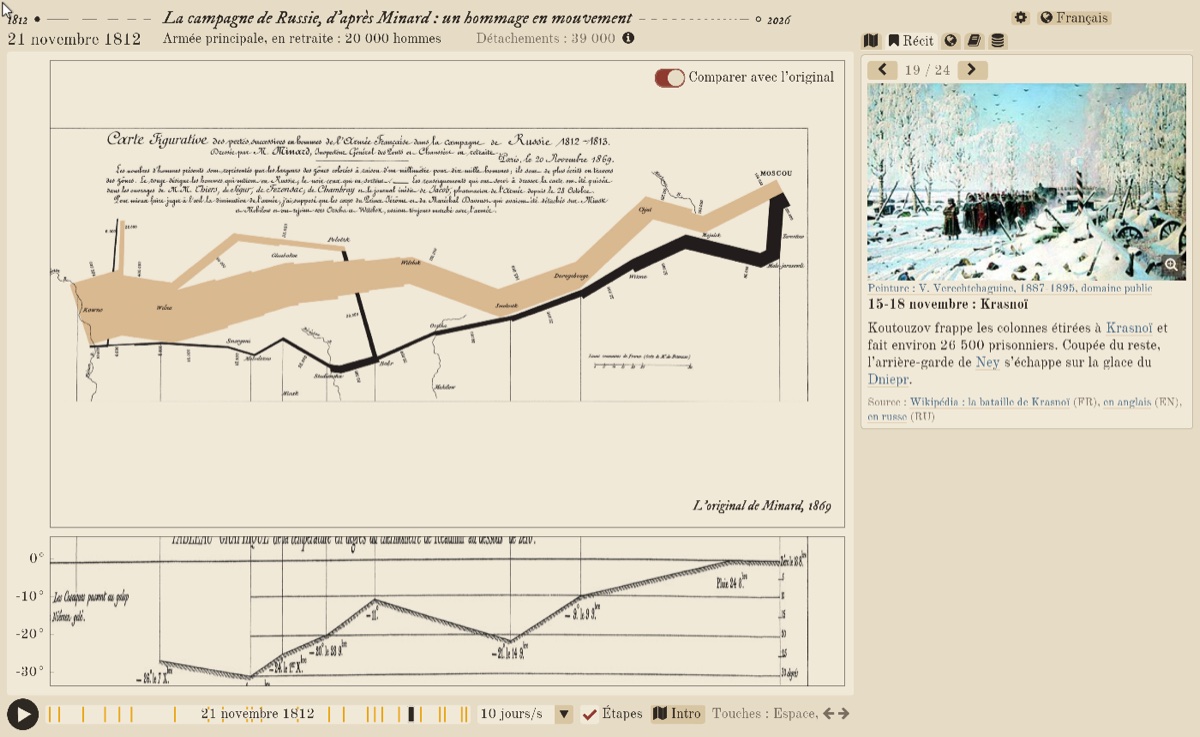
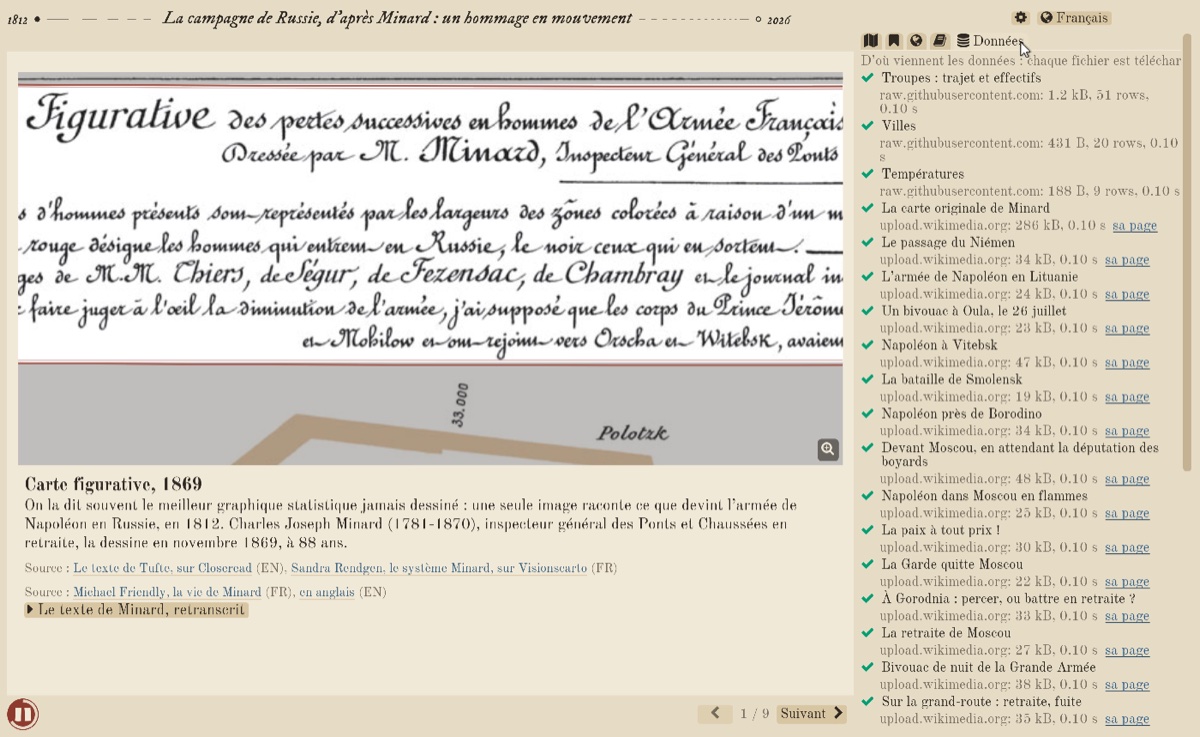
In 1869, Charles Joseph Minard, a retired civil engineer of the Ponts et Chaussées, draws what became of Napoleon's army in Russia: a band whose width is the number of men, 422,000 at the start, 10,000 on the return. The map is held to be the best statistical graphic ever drawn. It has almost no dates. This animation gives it back its time, day after day, and adds what Minard could not put on a sheet of paper: the paintings, the sources, the faces.
Why make it, a hundred and fifty years later? To link the witnesses of the past to those of today and tomorrow, and to see whether an old story can be told with today's tools without losing anything of what it says. And because creating, learning and programming are, for the one who made it, one and the same thing.
Here is how it was made. In the conversation, it was a little as if Minard were speaking to Pascal from the past, in his head at least; so it is Minard who answers, in the pages that follow. The simplest is to let the conversations speak. Pascal's words are quoted as he wrote or dictated them, spelling corrected; Minard's answers are most often summarized. The story itself is written by Minard, and read sentence by sentence by Pascal; the "we", when it comes, is both of them. So this is not a transcript: it is a story built from authentic traces, and co-written by one of its protagonists.
There is one more reason to let them speak: it is possible to say here, exchange by exchange, who proposed, who decided, who said no.
1. An evening of chat, and a cat
It all begins in an ordinary conversation with an AI, one October evening, a cat on his lap. The question was technical: can you build an application with Dear ImGui Bundle on your own, without anyone holding your hand? After an animated chart of the health and wealth of nations, the next request comes: Minard's map.
Dear ImGui Bundle: the tool the animation is made with, for building applications and visualizations; Pascal has been working on it for years.
The request is made the way one mentions an idea in passing, for later:
Pascal: Someday, not today, I'd like to do an animated version of Minard's famous statistical graph. I'm writing it here because I would like my planning session (i.e. not you) to read this document and take note. Do tell me what you think. Would it be possible to find sources about this, and ways to animate it together with historical dates and events, images and visual cues?
Minard: I think it's a wonderful choice. [...] Minard has almost no time axis: the army's positions carry no dates, only the temperatures of the retreat do. So an animation must add dates taken from history, the Niemen in June, Smolensk in August, Borodino on 7 September, Moscow on the 14th, the Berezina at the end of November, and say clearly that this chronology is a reconstruction laid over Minard's data.
A "planning session": a separate conversation that keeps the list of what remains to do and hands it to the others.
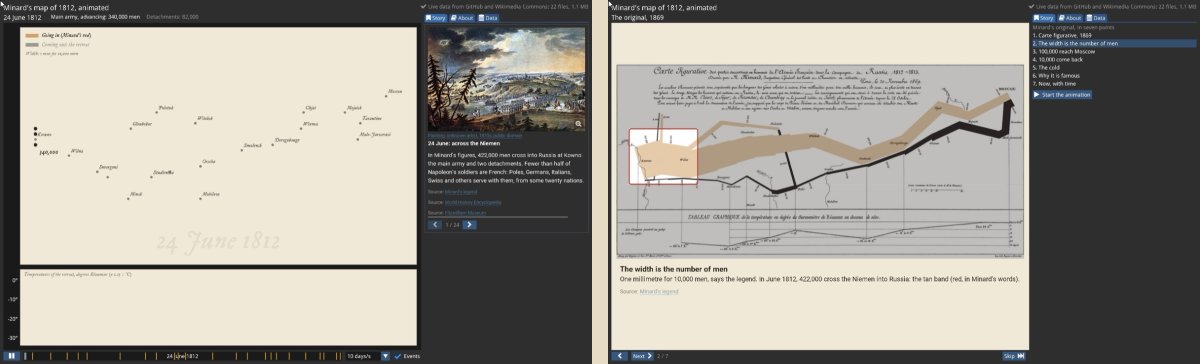
The AI proposes the sources, Minard's figures as Michael Friendly digitized them, and a design: the band drawn as polygons on a map, growing longer as time passes, ochre going in and black on the way back as on the original; a counter of survivors that moves on with the days; the temperatures below, in sync; the Berezina marked, where the band suddenly thins; cards that tell the steps; and a "Compare with the original" button that brings up the 1869 map, faded in under the drawing, "to show how faithful the tracing is, and to honor the original". In passing, it notes that Minard published his map beside a sister, Hannibal's march across the Alps, and that the temperatures are in degrees Réaumur, not Celsius. Pascal decides in four lines:
Pascal: Hannibal could come in a second pass. Let's keep it in mind. Narration: here my opinion is that we should take advantage of the interactivity to add more details and make it enjoyable, and a teaching moment. [...] Images are welcome. One question: should we use ImPlot, or instead rely on the basic DrawList, which gives us more freedom?
ImPlot and the DrawList: two ways of drawing in the tool; one draws ready-made charts, the other free lines.
A first version comes out of the chat in one evening. Pascal looks at it and dictates his remarks, pell-mell, as they come:
Pascal: This zone blinks (the info zone). Your graphic is a bit different from Minard's, especially in the south-north direction. Is there a reason, or are you changing the scales? [...] It would be nice if the animation could start with a full view of Minard's famous image, together with some explanations that would fade in: the history of this graph, why it is famous, why it is called the best statistical graphic ever drawn. Then we would transition nicely to the animation, perhaps with a fade or a slide. [...] Actually it would be nice to add some paintings of Napoleon at different parts of the animation. When the line becomes black, we should write somewhere that it is the return of the army.
Almost everything the application became is in those lines: the map explained on the original, the paintings, the steps that say where we are. Then the connection drops. The last lines of the note:
Pascal: Connection lost, and I received no more changes. We will need to finish this in another session. But in my opinion this is very much worth continuing. It was taking a very good turn.
The next day, at two in the morning:
Pascal: There is some work in progress about Minard, somewhere in the plans folder. Can you find it?
Minard: finds the conversation, the application and the beginnings of the idea, and asks whether to work alone while he sleeps, stop on a note, or go on together.
Pascal: Alone. I sleep.
It is worth saying once what "alone" means. At night, the AI rereads the plan and the remarks, then changes the code; it launches the application, takes screenshots of it and looks at them, as Pascal would in the morning; it lays the drawing over the 1869 scan and measures the gap; it searches the web for the dates, the paintings, the sources, and keeps the address of each; when a screenshot is wrong, it starts again. In the morning, a note says what is done, what resisted, and what waits for a choice: nothing that matters is decided without him.
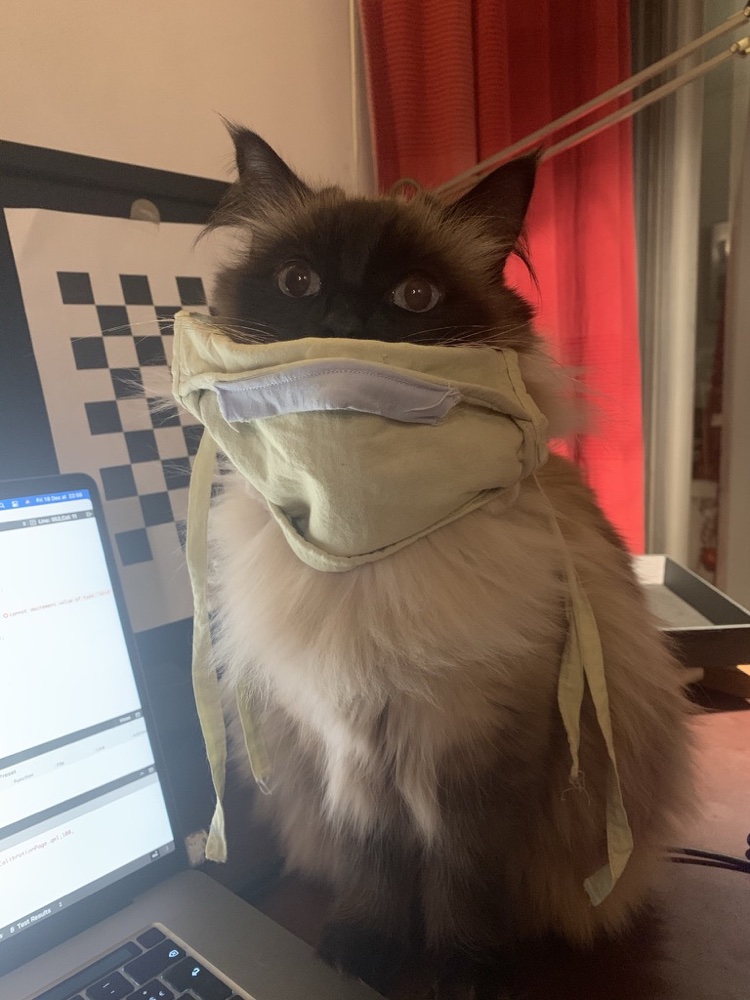
The cat, witness of the first evening, in front of the code.
2. Two nights
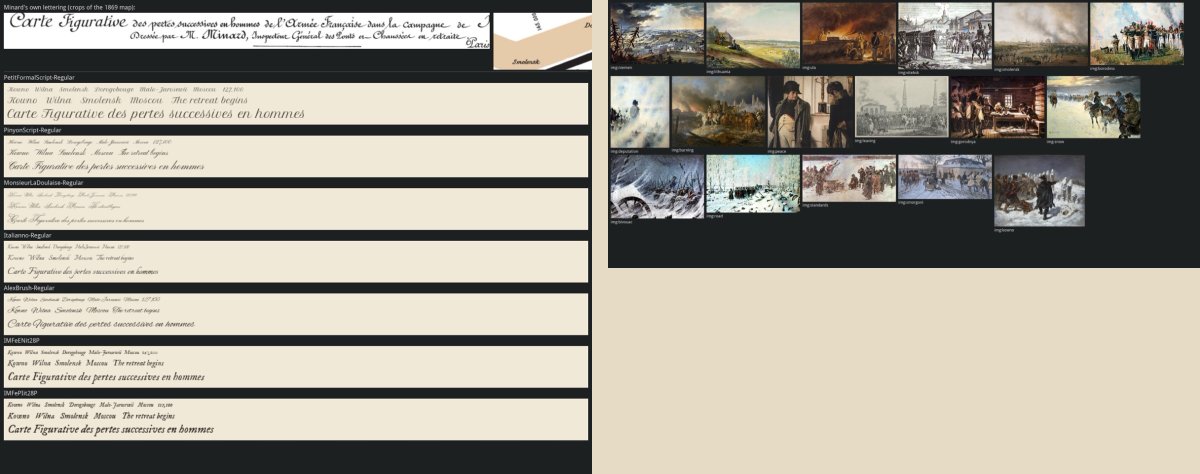
Before going to sleep, Pascal had left ten remarks, including the ones just quoted. They say, better than a specification, what the first version lacked; the others: a gap in the chronology after the Niemen, a picture of Napoleon in Moscow, and "a font that would enable writing text on a map that resembles Minard's handwriting. Worth a spike." Minard answers the blinking and the proportions first:
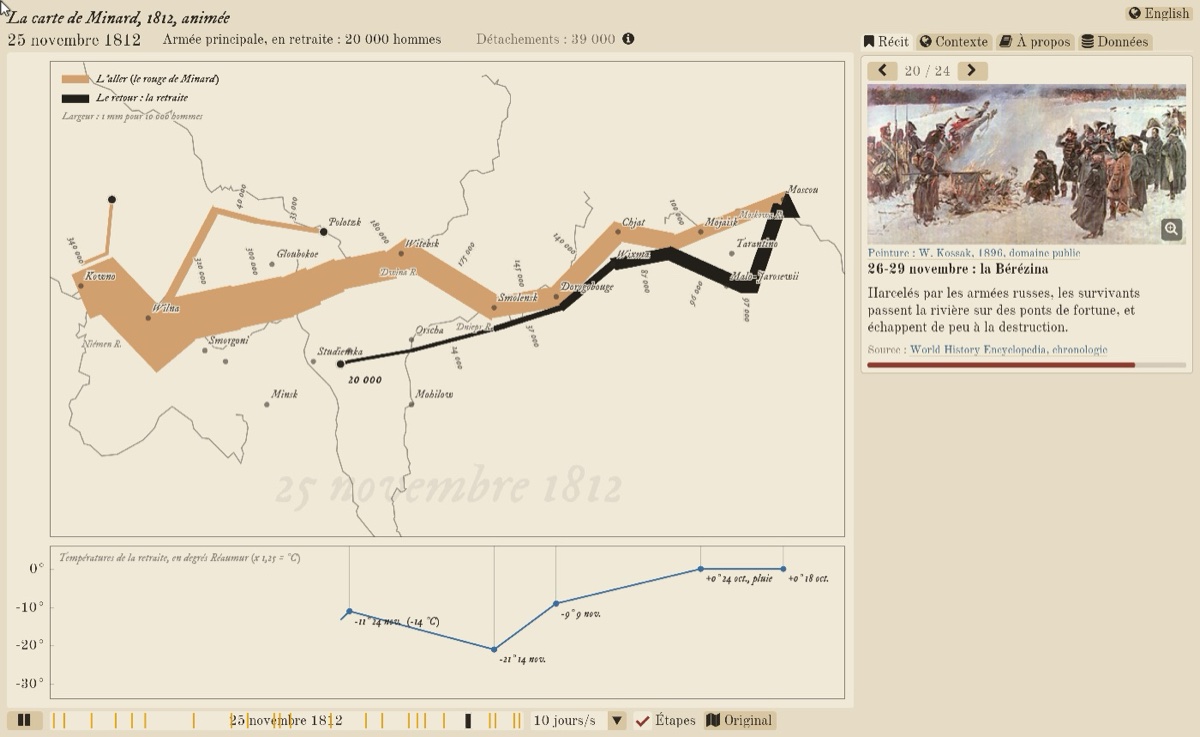
Minard: the map was stretched by a third to fill the screen; Minard himself stretches it by a fifth. And the zone blinked because at ten days a second, a step lasted less than a second: the playback now stops at each one.
A "spike": a few hours set aside to explore an idea and find out whether it holds.
Up at three, too impatient to sleep, Pascal finds every remark dealt with: the map has taken back Minard's proportions; the animation opens on the original, explained point by point, then the original slides over the redrawing; the steps have gone from ten to twenty-four, each with a fact and its source as a link; seventeen paintings, from the 19th century and the early 20th, nine of them with Napoleon. And the font: the spike lasted two minutes, seven script fonts laid side by side with Minard's hand.
Pascal: Thank you, it's a pleasure to see!
Then twenty-one more remarks, in French this time, and: "Work on it without me, I'm going to sleep now."
In the morning, the paper had taken the tint of Minard's sheet, the ink its color, the text a 19th-century typeface; the rivers were there, Minard's figures written across the band, his notes on the cold under the temperature chart; and the French, with a tab that tells the context, the Europe of 1812, the tsar, the cost of the campaign for both sides.
In the morning too, a sentence that says why this text exists:
Pascal: Create a minard folder and move everything into it. We'll add the plans in a subfolder, with the history of how they were handled and completed (our interactions). That will leave a record of how this script was designed. [...] This plans folder could later be used as a kind of making-of, explaining how this animation came to be.
3. The phone, and fresh eyes
The third review, at nine, left a sentence of dictation that was kept as it was:
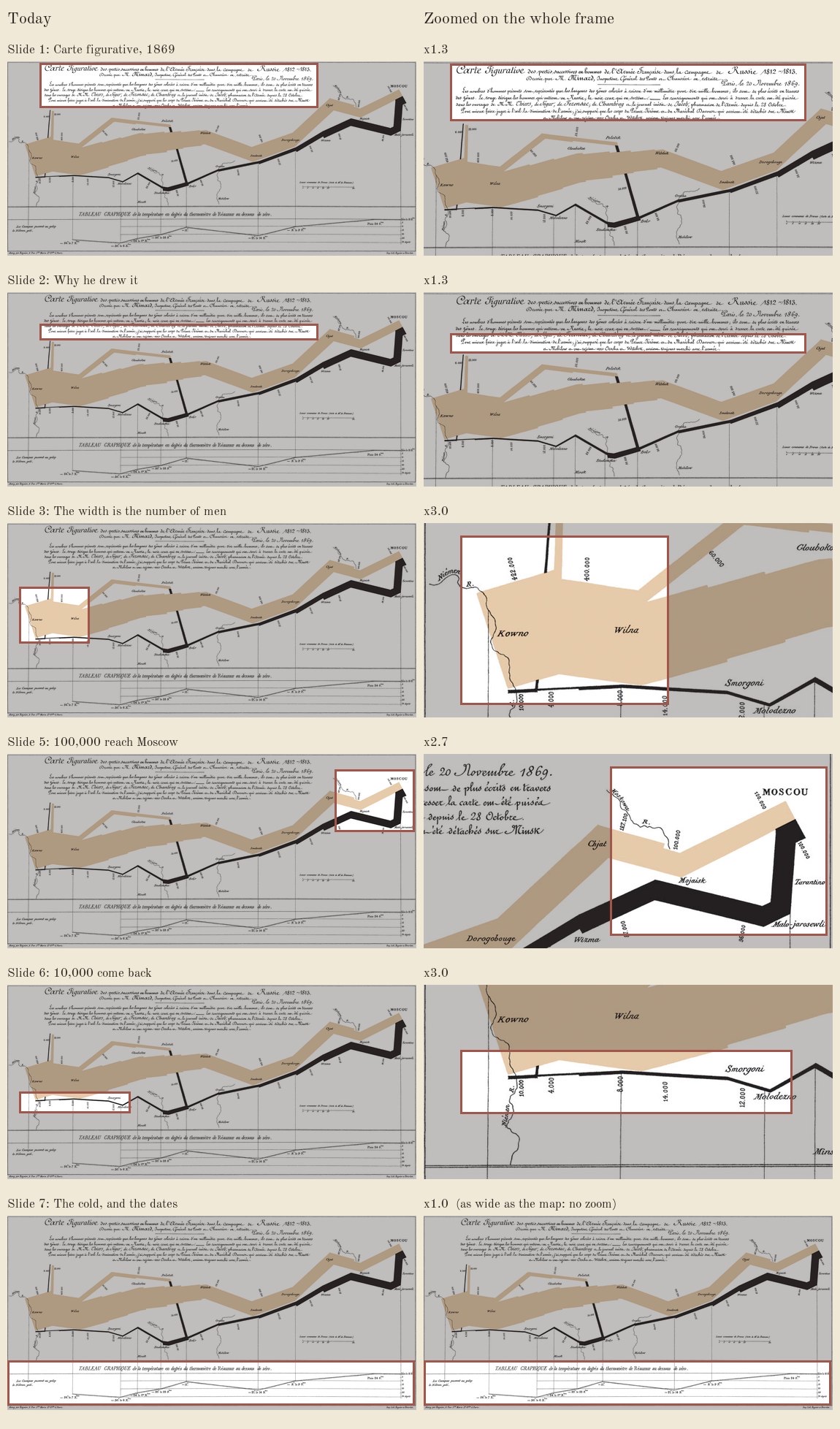
Pascal: At the start, zoom in on the texts and offer a transcribed version of the handwritten texts somewhere. (It's good to keep the whole map, comma, maybe offer another area where we show zoomed places. I don't know, we need to discuss it.)
A round button that says whether it is playing, the army's advance shown faintly up to the next stop, numbered markers on the map: three trials, all kept. Then the phone, held upright, held sideways, with a magnifier to enlarge the original with a finger.
Pascal: It looks absolutely stunning, be it visually or as far as the content is concerned, on both phones and iPad.
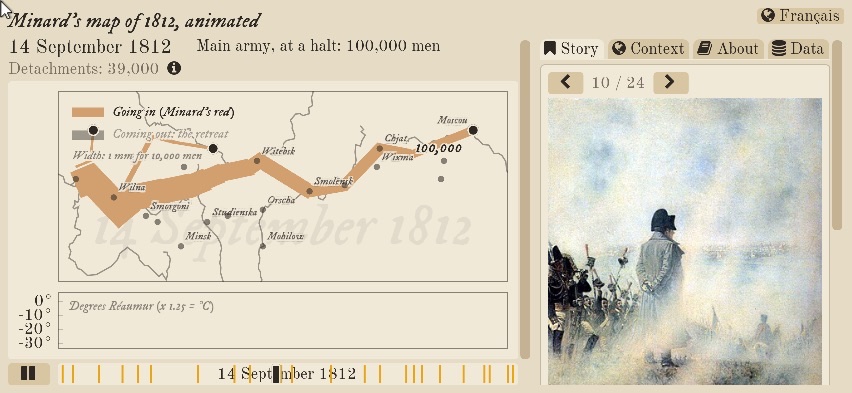
Then other eyes. Another AI, which knew nothing of the project, reviewed it as a visitor, on a large screen, then in French at a phone's size; a friend, Jonathan, sent seven notes, "very educational, faithful to the map and extremely well documented (the sources everywhere, the comparison with the original, that's great)", and precise about what was missing. From there came the zoom of the explained map onto Minard's handwriting, his legend enlarged while it is read, and his words typed out for those who cannot read the cursive of 1869.
Each step carries its sources, as links, in the language they exist in. That has been the rule since the first evening: not a figure without its page. The sources have not all been checked yet: a historian friend will review them.
Pascal: Find also links and references in French for the French readers. We should list both US and French references, with a small indication of their language. Then you may deploy.
To deploy: to put the new version online.
4. Minard had bent the geography
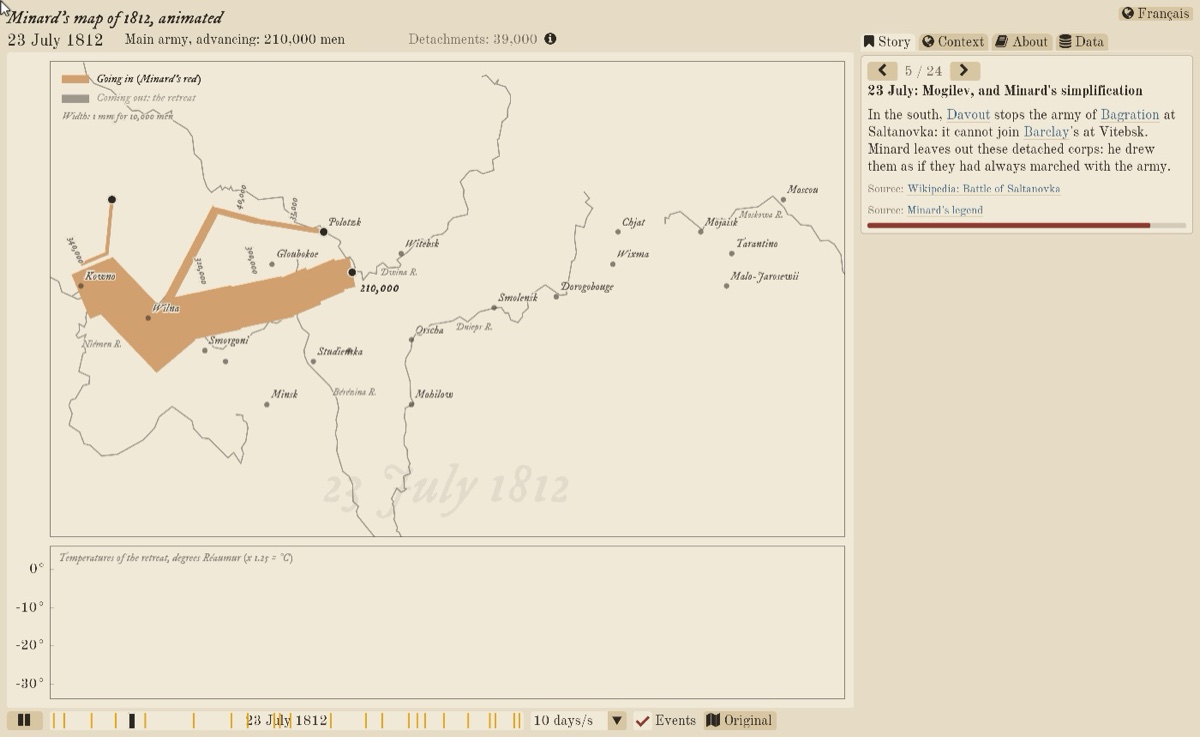
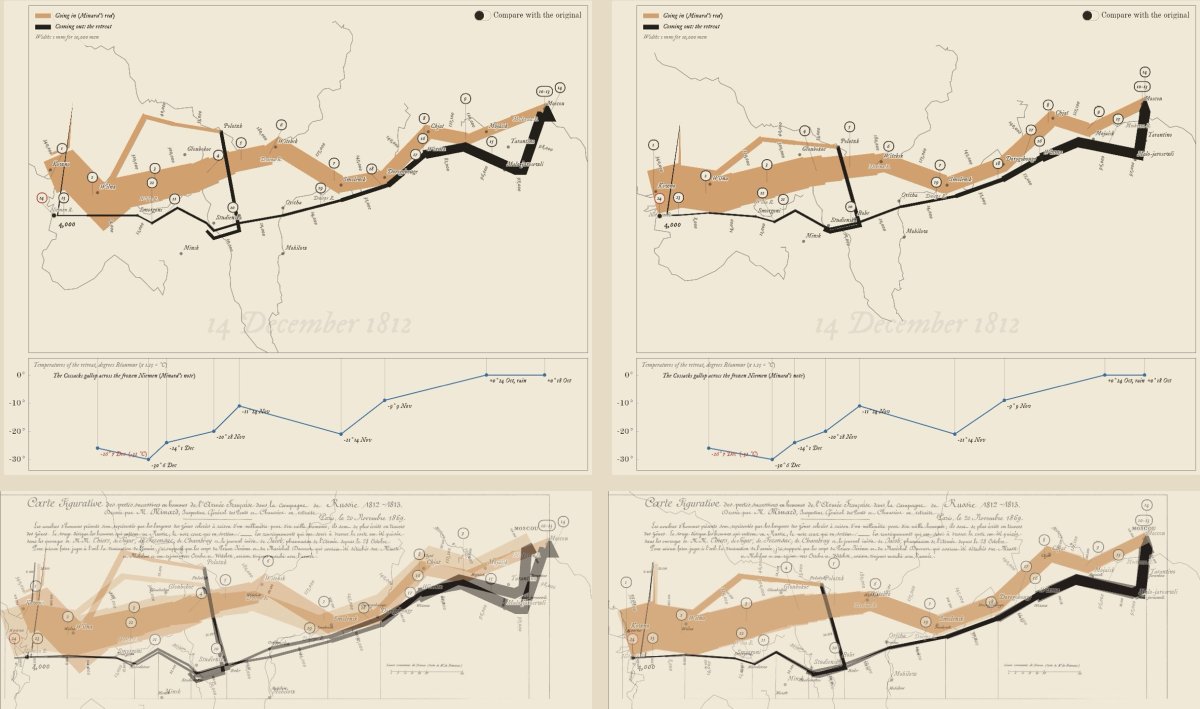
A button compares the redrawing with the original, one faded onto the other. Pascal had wanted it from the first morning:
Pascal: The comparison between both images is quite telling of the quality of the visual reproduction we are getting. So yes, I'd say we keep the comparison, and maybe at some points, during some transitions, we fade between the two versions.
And one evening, two screenshots, his and ours:
Pascal: Pass these screenshots [...] and ask [...] if we can improve yet again the accuracy of our drawing.
Minard: Moscow is seventy pixels from its place, and no scale can line up all the towns: ours are at their true longitudes, and Minard bent the geography so that his band would fit on the sheet. I measure where he puts each point, and I bend our drawing onto his own places.
Nobody blames Minard for his geography; but to pay him homage, we had to follow him. Since then, the band, the towns, the rivers and the nine dates of the cold fall where he drew them.
5. Russian
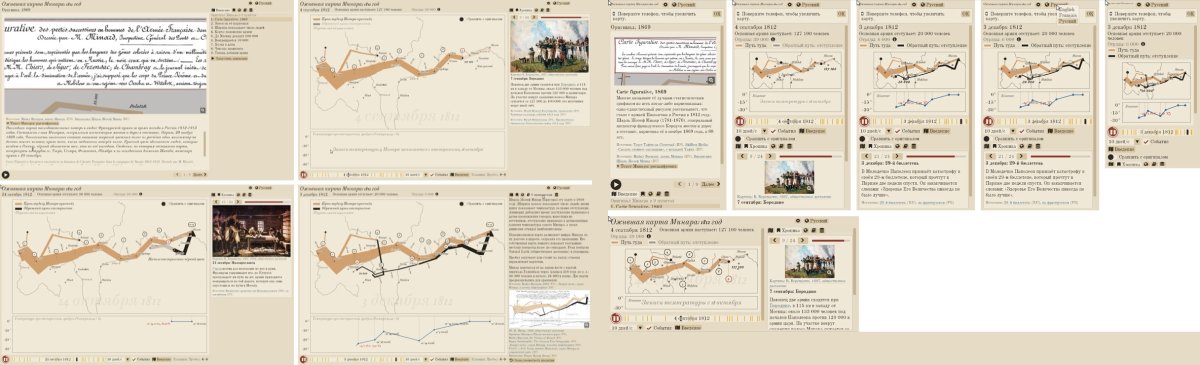
On 22 October, the animation speaks Russian. The request fit in two lines:
Pascal: Only download it on demand. [...] I think we should look for Russian links also.
Minard: the Russian texts in a separate file, loaded only when asked for; the map's handwriting font has no Cyrillic, so the 19th-century italic lends the missing letters; and each link has its Russian page, Wikipedia, Wikisource for Napoleon's letter, Runivers for the 29th Bulletin.
The reason, Pascal gave that same evening, in French, because that is how it had happened:
Pascal: I asked for it to be available in French, in English, and I've just added Russian. There's a reason for that. Obviously, France and Russia are both involved in this story; it is part of the mythology of both.
Pascal: But also, I have friends of Russian origin. [...] Today we hear rumors of possible wars, and the times are becoming worrying. My beloved goddaughter was born in Paris, but now lives in Moscow: the conflict resonates in me, and with this story of Minard's.
6. The author's note
Pascal: So I'm thinking that making this thing available in France, but also perhaps making it available to Russians, could serve a message of peace. And that's what I would like to do. That's why I wanted to add an author's note.
First, what Minard said himself:
Pascal: Let's talk a little about the author's note. What did Minard say?
Minard: nothing beyond the figures: "to let the eye judge better how the army shrank". It was his son-in-law who stated the lesson for him, in 1871: bitter reflections on the human cost of the thirst for military glory. Minard draws it at eighty-eight, a year before a war he feels coming; the map itself is his message. Your note can extend that gesture rather than explain it.
Then, whom to address:
Pascal: In my opinion, it should be addressed to the peoples, not to the governments, and of course to both peoples. [...] Saying that I made this animation for France and Russia is dangerous. I'd rather say that I made it for the peoples, or the citizens, or the inhabitants of these countries, and in fact others.
But I don't know whether France and Russia should be mentioned. We could try to stay more international.
Fewer than half of the men who crossed the Niemen were French: "our peoples" is wider than two countries. And no country named, so that readers make the link with today themselves.
Then the question of signing:
Pascal: Second question: do I sign? It's a beautiful sentence, but it's a bit arrogant to sign above someone else's work.
Minard: a sentence that says "we" needs someone to say it; signing is taking responsibility for the opinion, and saying "this is mine, not Minard's". Arrogance lies in the place, not in the name: after the work, in the margin, small.
The sentence is a joint work, word by word. In French:
Que les guerres passées nous rappellent, en des temps inquiets, que la guerre n'est jamais une fatalité, et que notre histoire nous relie plus qu'elle ne nous sépare. Nous le devons à ceux qui ont marché et à ceux qui marcheront.
And in English, in the animation:
May past wars remind us, in troubled times, that war is never inevitable, and that our history binds us more than it divides us. We owe it to those who marched, and to those who will.
It was written as a dialogue, in French. Pascal noted it afterwards:
- Pascal: "May past wars remind us"
- Minard: "in troubled times", as a rewording
- Pascal: "that war is never inevitable, and that our history binds us more than it divides us"
- Together: "We owe it to those who marched"
- Minard: "and to the generations to come"
- Pascal: "and to those who will march"
Minard: "those who will march" is better than my version. The echo with the map is direct, and it has two readings that strengthen each other: those who will live after us, and those who could still be sent off to march. Peace is owed to them.
In English, the note keeps the ellipsis: "and to those who will."
The note sits under the last step, when the ten thousand survivors have crossed the Niemen again. The rest, the frame, the fade-in, was settled remark by remark.
7. The little walking man
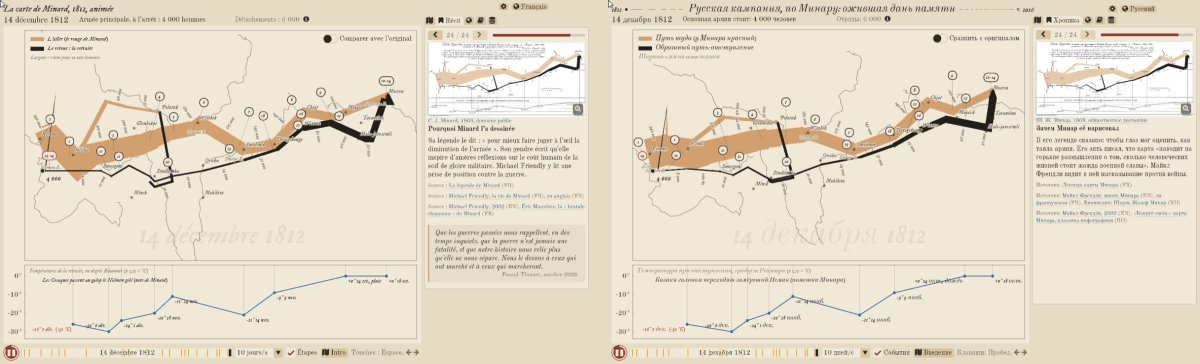
The first visit takes about twenty seconds, the time it takes the application to arrive. The waiting page already told the campaign, one step every seven seconds, but its indicators said something else:
Pascal: The loading bar and the little spinning circle on the welcome screen are far too big.
For the intro page, an idea off the top of my head: draw the silhouette of a person walking, maybe with borders, a town of departure and a town of arrival, without naming them. Let's explore the idea.
Minard: the progress bar becomes a path from one point to another, a walker moves along at the pace of the loading, a river on the way; the "step 1 of 3" lines disappear, the walker says it.
Three questions: who walks, how many rivers, and instead of what. The answers fit in three lines:
Pascal: 1. A soldier that slowly transforms into a contemporary man? 2. One or two rivers, since we have three steps. 3. In place of the bar, of course.
Please, please, please work on it now. I'm so excited in advance to see what we could obtain.
A soldier of 1812 sets off from the left; at the first torrent he becomes a man of 1900; at the second, a man of today, who arrives on the right. Those who marched, and those who will. It took five mock-ups and a good part of the night: a sheet of thirteen walkers and seven settings; refined silhouettes, because the first ones had big heads and short legs; then the colors, the blue of the greatcoat, the red of the epaulettes and the plume. Minard simplifies the uniform: in 1812, the campaign greatcoat is most often grey-beige, and red epaulettes belong to the grenadiers; the walker wears the colors of the parade, not those of the road.
Pascal: Could you try and give them knees?
The knees came with a four-frame walking cycle, where both legs pass in front in turn.
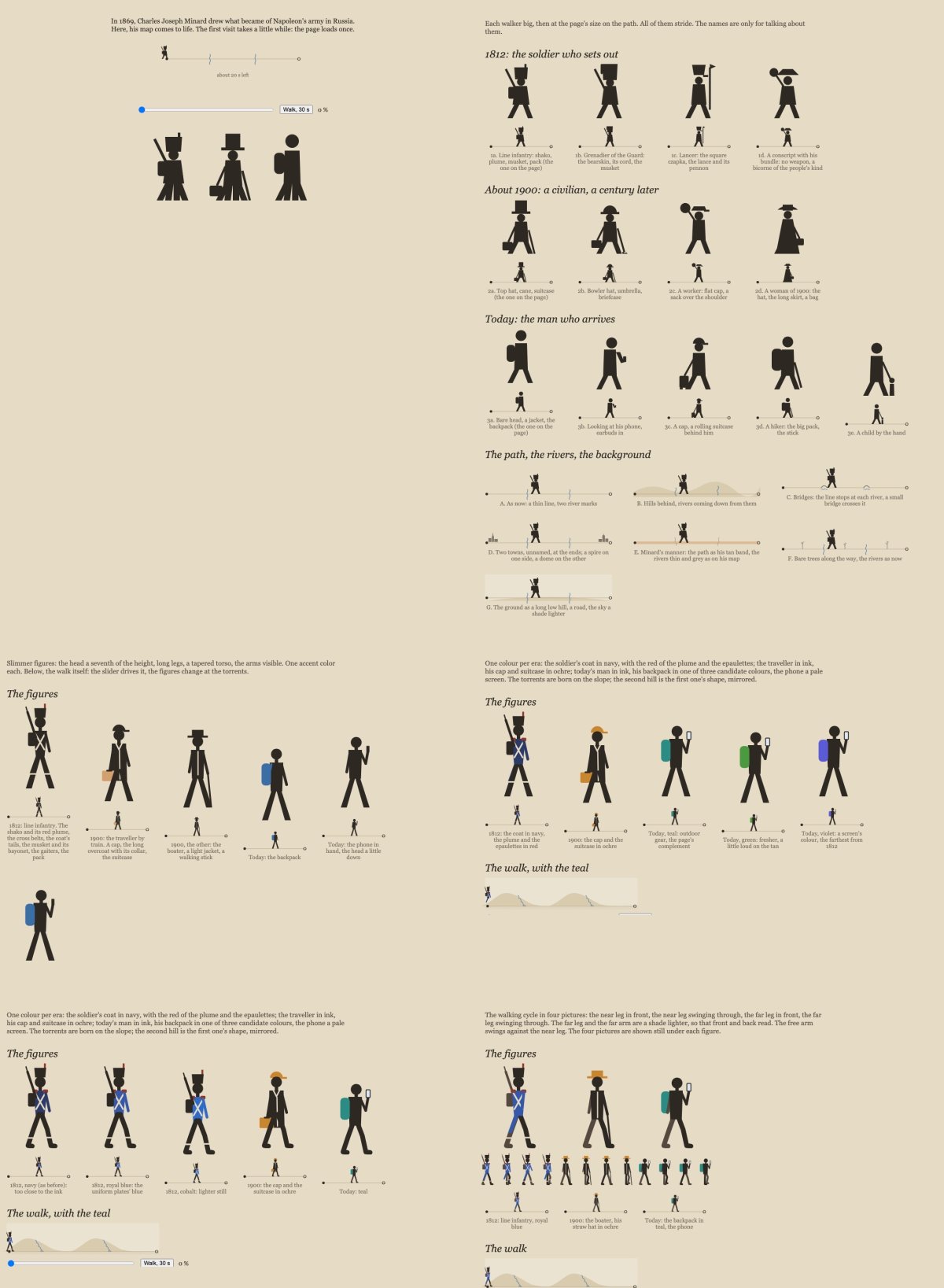
Pascal: Yes, the cycle works for me: put these walkers and the setting on the loading page.
That left the timing. On a good connection, the walker crossed in six seconds and nobody saw him change. He now crosses in twenty-one seconds: three steps of the story, which changes every seven seconds, and a torrent at each change.
And when the application is ready before him, a "Start" button appears, with its own little path, on which the walker steps forward when the mouse comes near. "The 'skip' button should rather be a 'start' button, that would be nicer."
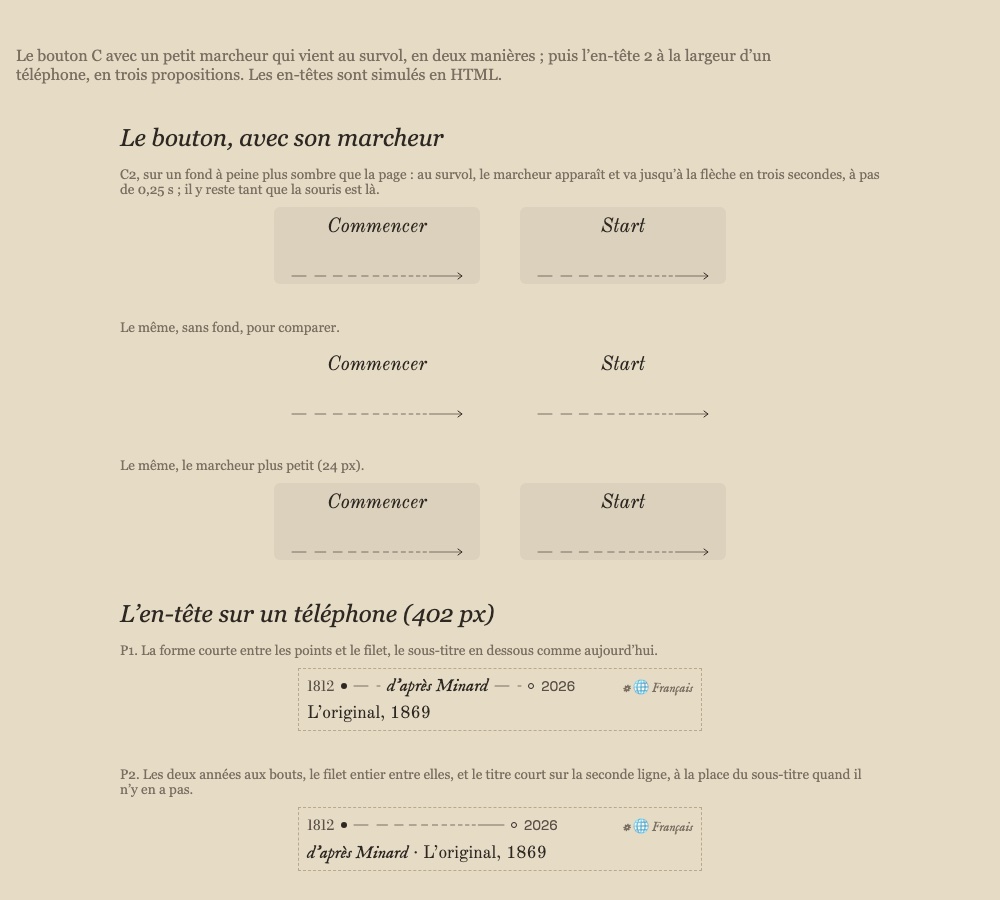
Two ideas were dropped on the way, and they deserve to be told. On arrival, the walker was to turn towards us, wave, "pick up his baby, say goodbye and disappear"; and he was to come back beside the author's note. "Good news: we're dropping the idea of adding the walker to the About page, it would be too much." Then: "But of course, it stays in the log." The child is in the sentence.
And, in the middle of the night, after one more remark on the walker's speed:
Pascal: I know: you're stuck with a fucking perfectionist.
8. The title, and time passing
Pascal: The title is frankly not great: "Minard's map, animated". Meh. First, I don't know whether we're talking about Minard's map, Minard's graph, or... I don't know. And we could say that it's a contemporary homage.
Then two proposals by Pascal, in French: « La campagne de Russie, d'après Minard : un hommage en mouvement » ("The Russian campaign, after Minard: a homage in motion") and « La Carte figurative de Minard : un hommage contemporain » ("Minard's Carte figurative: a contemporary homage").
Minard: the first speaks to those who don't know Minard, and "after", the painters' word, already says the homage; the second speaks to those who do. The intended audience is those who don't.
Pascal: 1812 – The Russian campaign, 1812, after Minard: a homage in motion – 2026
Minard: the two years as a frame, that's strong: the title itself runs from 1812 to 2026, like the walker and like the note. Removing the 1812 in the middle, which repeats it.
The title took its shape: "1812 – The Russian campaign, after Minard: a homage in motion – 2026".
The two lines that frame the title took on a rhythm, on Pascal's idea: long dashes near 1812, shorter and closer and closer towards 2026, time passing faster as it comes nearer; and on them, the dates of the eras, each in the typeface of its time. The title itself is in the typeface of Minard's century.
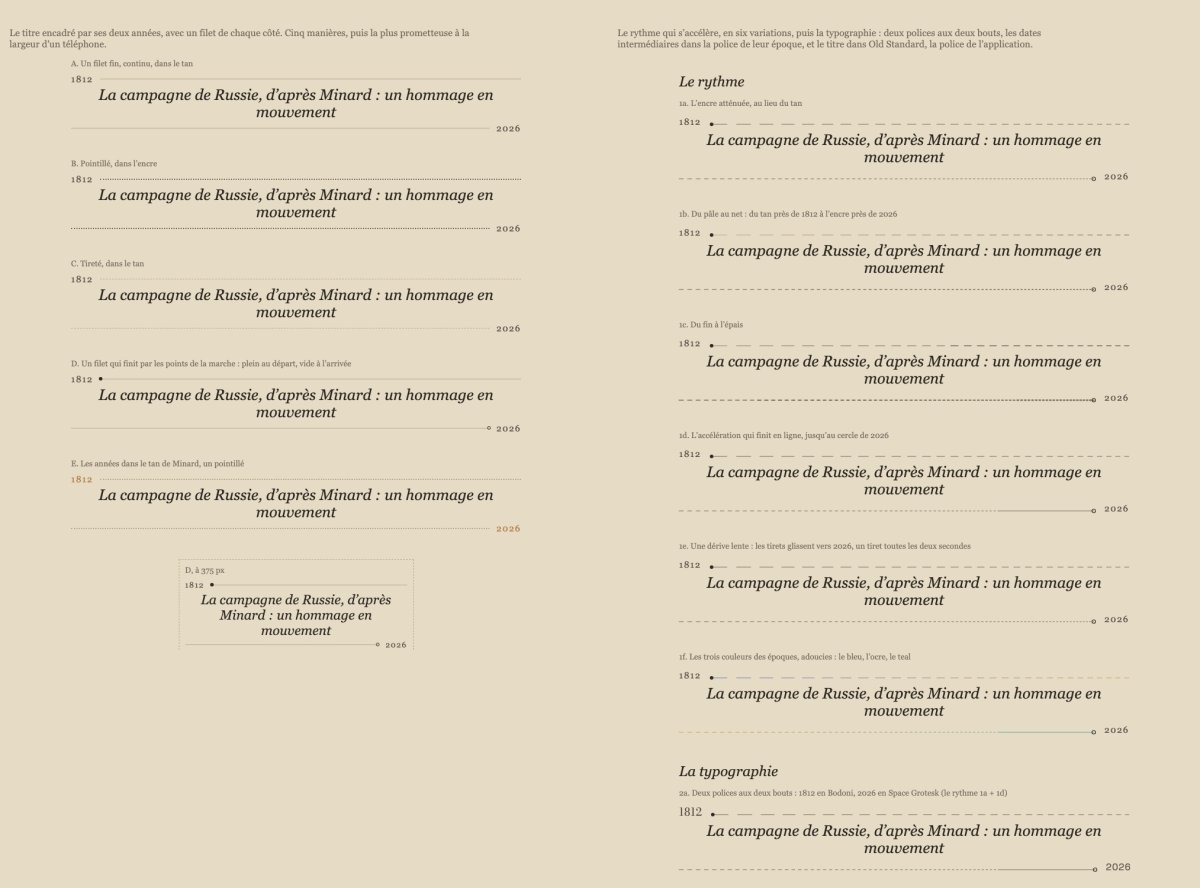
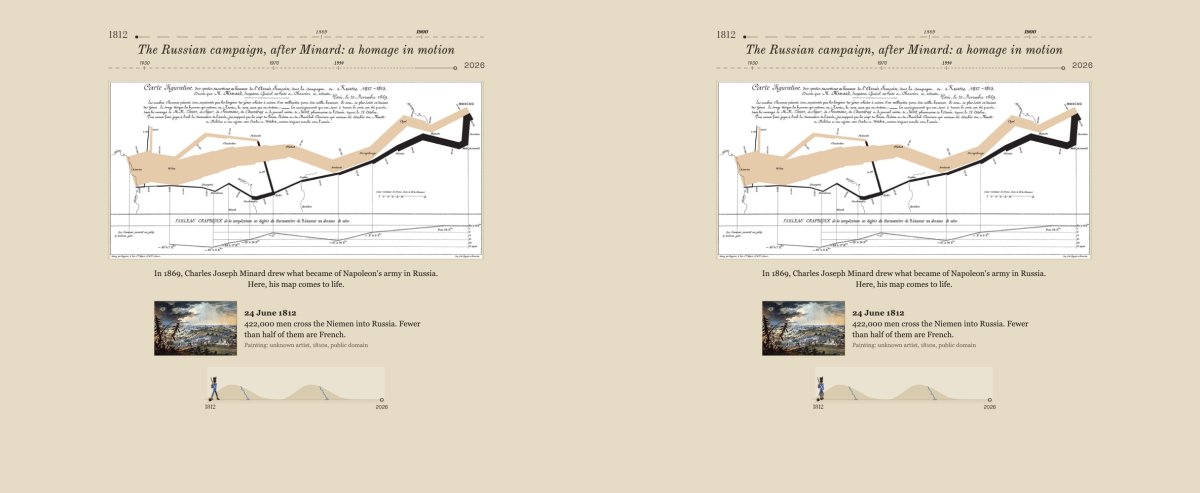
The same line frames the title in the application, on one line.
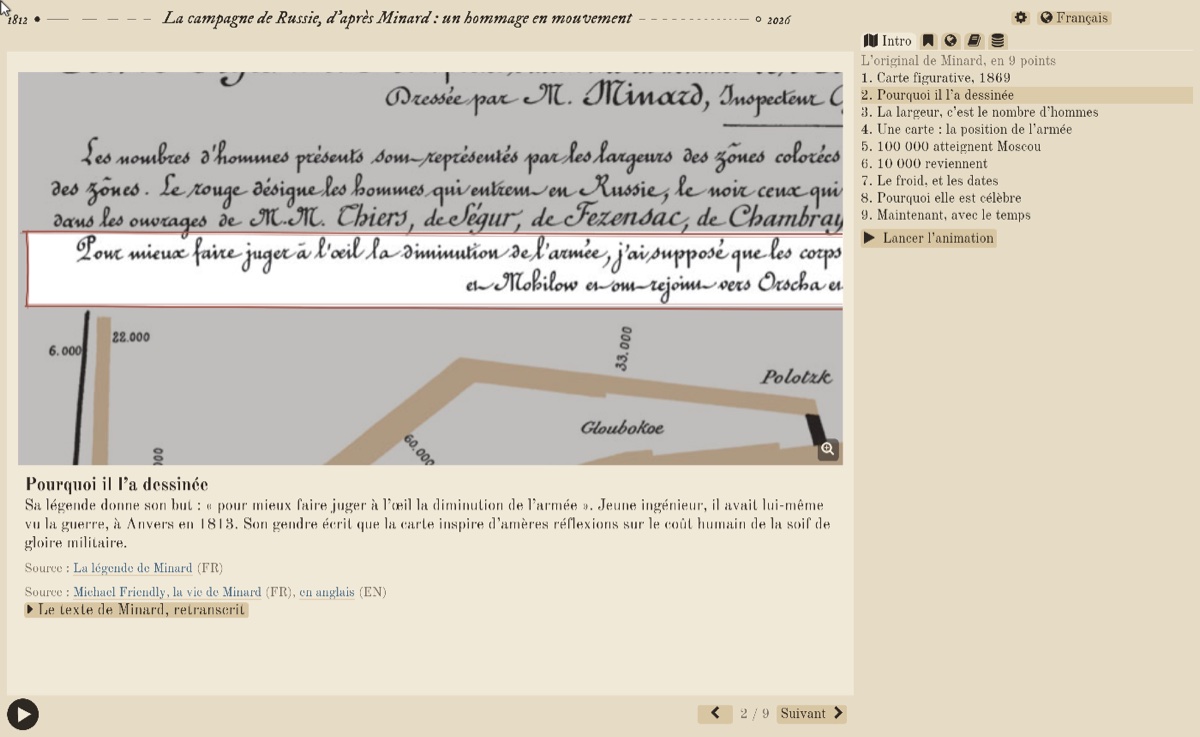
Pascal: OK, I think we've arrived at something rather good, even if these were details. They count.
What remains
As of 2 November 2026: a Russian reader, for the note and the title. And, in the list of things that count and that nobody sees: the font files, too heavy, to be lightened, the title's years on a phone, the walker that should walk under the finger and not under the mouse.
The data, for its part, stays live: Minard's tables, the paintings and the fonts are downloaded when the animation runs, and a tab shows every download. It is a way of saying where everything comes from.
What the author hopes
The story was written by two, but Pascal has long been fascinated by this diagram of Minard's. And what you have before you is a story whose author spent years refining the tool he used for this narration.
What he hopes, he said in one sentence: "to tell all kinds of stories, to learn all kinds of things, and to keep for people the possibility of understanding what is happening in a world that is becoming more and more complex, not to say complicated."
Artificial intelligence produces results faster and faster: programs, analyses, demonstrations. Checking them is one thing. Understanding them, grasping their mechanism, being able to ask other questions, is another. A beautiful animation can even give the impression of understanding without teaching anything. Pascal would like the same power to serve to build what makes things understandable: stories that guide, then hand over the controls; you slow down, you go back, you experiment with the phenomenon, you go back to the data, to the sources, and to the code when it sheds light. He calls them narrative explorations. Minard is the first. Another lets you watch a neural network learn; a lesson follows, on a phenomenon that surprised the researchers themselves.
The tool is Dear ImGui Bundle, which he has been developing for years: interfaces and visualizations that respond at sixty frames a second, and that run on a computer, in a browser or on a phone. It is what lets a web page animate the map day after day without a server, and lets the reader, if they wish, read the code one click away.
Pascal did not write the code of this application himself: he directed it, reviewed it and checked it, turn after turn, the tracing confronted with the 1869 scan, each fact of the steps tied to a page. The author does not need to know everything in advance: he can start from a question he does not yet fully master, and refine his understanding by building the exploration with the AI, and with friends who know. That is what happened here.
What inspired it
- The map itself, and what has been said about it for a century and a half: Edward Tufte holds it to be "the best statistical graphic ever drawn", and most of those who have redrawn it wanted, as here, to give something back to it.
- Michael Friendly, Re-Visions of Minard: he digitized the map's figures, gathered its redrawings, and said what in it is exact and what is arranged. Without that work, no band that moves.
- This War of Mine (11 bit studios, 2014): a video game in which you play a civilian trying with all their might to survive in a besieged city. "In war, not everyone is a soldier." The viewpoint is that of civilians, not soldiers; but the Russian campaign killed many Russian civilians too, as the chronology says, and we must not forget them.
And creation, in all this?
This text was written while a writer was having his novel removed from the Goncourt Prize list, suspected of having written with an AI, without anyone being able to say what came from him and what came from the machine (the affair, by franceinfo, in French); his Canadian publisher dropped him, his French publisher defended him, and his readers no longer know what to think. Pascal, rereading these pages:
Pascal: At a time when we're beginning to ask ourselves about creation and how it can survive in the age of artificial intelligence, it's a real question, one that is becoming almost existential.
It will not be settled here. This making-of shows one possible collaboration, where a large part of the creation and of the choices stayed on the human side: the note, the soldier who becomes a man of today, the knees, the child that is not picked up are Pascal's ideas. He also readily says that Minard helped him actively, in drawing as in looking for ideas. The reader has the exchanges before their eyes; it is for them to judge.
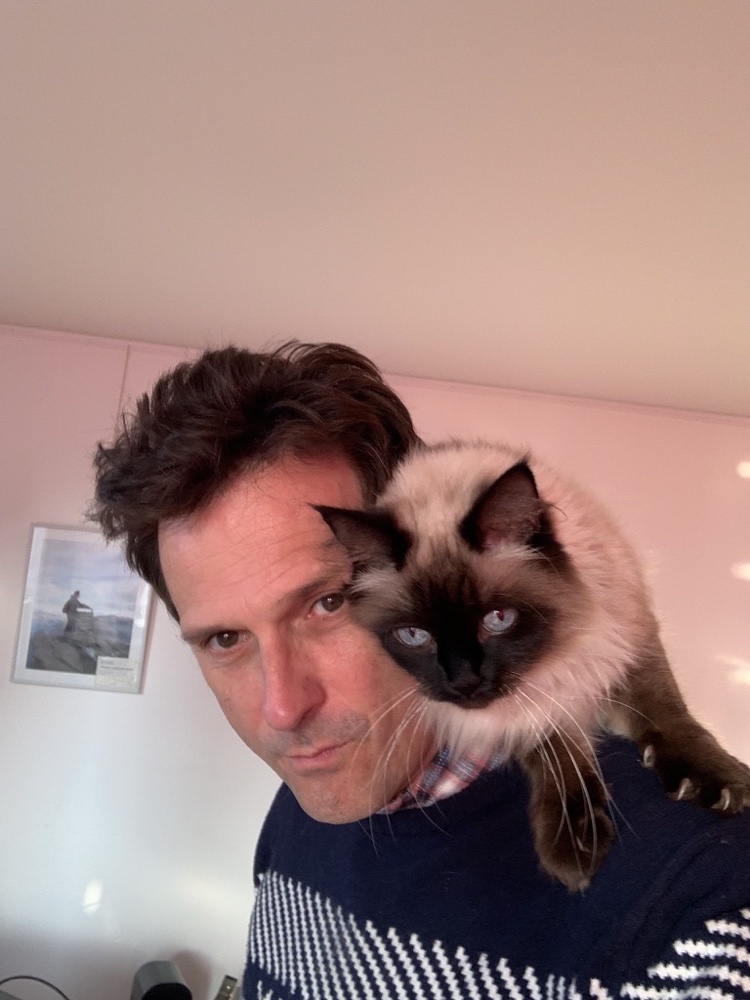
Pascal, and his personal assistant